Wednesday, 26 June 2013

Where it all began….


Sorry for the long break.  I’ve been away a lot, both business (a couple of visits to Dublin, which only gave a brief taster of the place) and pleasure (the annual visit to Orkney- which included the best weather I’ve see this summer).   I’ve also been having all sorts of issues over Flickr.  I tend to assume that most of my readership here is steered over from Flickr, where I tend to post at least some of the photos I include in my postings.  I really can’t get on with the “new look” Flickr.  I find it clunky and confusing to engage with- and so slow that I’m having to cut back the number of people I can engage with in any depth.   I’ve set up an alternative home on a site called Ipernity, whose look is a lot more like them old Flickr and rather reminds me of the old Yahoo 360 (anybody still alive who recalls that?).  I suspect it was a something of a French Flickr knock-off (if you look closely it’s apparent that the default language was originally French) and I also suspect that it was not the most active of places until a few weeks ago.   There has been something of a migration of girls I know and like from Flickr but (inevitably) there are still a lot of people I don’t want to lose contact with on Flickr who probably have too much invested in time and effort to want to move from there.  Equally it’s not yet clear that Ipernity will get the critical mass necessary to sustain interest (or indeed how the folk who run it will react if they suddenly become the default site for t-girls and their admirers- there is some evidence to suggest that their filtering for rude stuff isn’t all that well developed or robust!).   While Ipernity has a blogging facility I don’t think I’d be able to shift all of this over there.  So the net result is that I guess I’ll have to remain here and double post the photos to both Flickr and Ipernity.   This in itself has been a bit of a discouragement from setting finger to keyboard…..As a result, I’m well behind on writing up the exhibitions that I’ve been to, with the result that some of my comments are going to be very much in the past tense.   

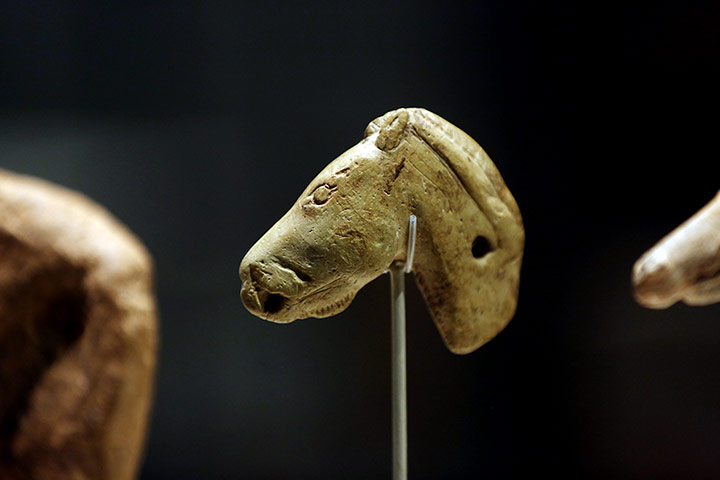
This certainly applies to the British Museum show on Ice Age Art.  This was sub-titled “The Making of the Modern Mind”, which certainly raised a few questions in my (hopefully modern) mind.  Part of the point of the show was to exhibit artefacts from the very distant past (anything up to 40,000 years ago) as works of art rather than simply archaeological finds; to underline the point, a number of 20th century pieces were slipped into the exhibition.   I don’t have any real problem with this- there is pretty good evidence that Picasso, to take one example, was interested in and influenced by examples of Palaeolithic art which were discovered in France in the 1930’s, like the example below.


I’m a little less than totally convinced by the associated argument that the Ice Age societies in question included what amounted to a group of “professional” artists who underwent lengthy training (argued on the basis of finds made by clearly less skilful hands- interpreted as apprentice works), though it’s certainly clear from attempts to replicate some of the more complex items on display that creating them might take several hundred person hours which couldn’t be spent hunting or gathering.   The assumption that creating sophisticated visual art is constitutive of a “modern” mind, however, jars just a little.   What about cultures which chose other ways to address the issues that the groups covered in the exhibition dealt with in visual terms?   There was glancing reference to music (a flute made from the wing bone of a very large eagle) and even to dance (there is evidence from one of the decorated caves in France that people danced there- but might there have been dancing at sites which had not been modified by human hand?) but nothing about language and oral cultures.   There are societies in the contemporary world which are no great shakes at visual arts but cultivate very complex verbal cultures.  Don’t they have modern minds?   I imagine the concepts and the underpinning brain science are quite a bit more complex than they appeared in the exhibition catalogue, which at times read faintly like an impact report from the Paleolithic Arts Council seeking extra mammoth steaks on behalf of creative artists….

None of this questions the power, beauty and sophistication of many of the pieces in the show.  Ironically the least effective part of the exhibition was the section which sought to display the most famous Ice Age art- the cave paintings of Lascaux and their equivalents (badged up as examples of a “Renaissance” as the ice receded northwards some 20,000 years ago).   Obviously this sort of art can’t travel and the attempt to display it in audio-visual terms in a pseudo-cave really didn’t work that well.  

On the other hand the show did a very good job of displaying free-standing sculptural artefacts, including images etched into ivory or horn or even stone.   The number of items on display was not huge, which meant that one could actually look at them in the round (though obviously the requirements of modern lighting meant that one had to use some imagination to get a sense of how they might have appeared in the flickering light of fires or torches; from archaeological contexts it appears that some at least were meant to be viewed under those conditions).   They also came from a relatively limited number of sites (presumably to simplify borrowing conditions), though ones spread over a huge geographical area, from Derbyshire to the southern edge of Siberia, and covering an almost unimaginably long time span (something like 30,000 years).

Despite the intention of presenting the exhibits in aesthetic terms as works of art, it was obviously impossible to avoid speculation about function.   I repeatedly found the word “enigmatic” cropping up in my mind when looking at objects.   Take the female figurines (see top).   These massive women with huge breasts and (possibly, sometimes) heavily pregnant are something of an Ice Age cultural constant with versions being found in more or less every major site across the entire period covered.   It’s less clear what they “mean”.   The tendency has been to interpret them as artefacts underpinning a fertility cult, with very grand speculative reconstructions of matriarchal social structures sometimes built on this (curiously a certain brand of feminist-inflicted archaeology doesn’t have any trouble at all with recycling notions of Primitive Matriarchy first dreamed up by a mid- nineteenth century German professor called Bachofen whose works became massively popular with the more occultist type of Nazi).   Even on that basis there are puzzles.  Are these supposed to be idealisations of “ordinary” women (how many enormously fat women would there have been in the average hunter-gatherer band, even granted that such groups are often more sedentary than they appear at first sight)?    Priestess/shaman figures?   Goddesses?   Is it significant that, with the exception of items found at one site, they’re always depicted as nude even though nudity was probably relatively uncommon in Ice Age societies?   Some of the figurines appear to have been quite deliberately smashed and disposed of.   Why?   Punishing the goddess when a pregnancy went wrong?   Shifts in the belief system that we can now only guess at?   Could they even have been children’s toys, broken when their owner reached puberty?


Some of the same issues surround the beautifully observed images and depictions of animals like the bison and the horse shown above.   There are, for instance, disjunctions between the range of animals depicted in art and those which the archaeological record indicates were hunted (or at least consumed- it’s entirely possible that Ice Age people scavenged dead mammoths rather than hunting living ones).  To take an example, only one image of a wolverine has ever been found (it was in the show) even though these giant members of the weasel family were evidently hunted for their fur (and were quite fierce enough to pose a genuine test of skill and courage).   Again the assumption is that animal depictions link in with factors like seeking the aid of Higher Powers for a successful hunt, taking on the spirit of chosen animals at certain times or even totemic symbols of certain groups.  It’s easy to see why one might admire the speed of a horse or the ferocity of a bear and wish to take on something of their spirit -or want to apologise to a bison for killing it so that its spirit doesn’t haunt future hunts or say thanks to a mammoth for feeding the group through the winter.   Quite why a wolverine wasn’t due the same degree of respect is less clear…..  And just possibly there was no religious purpose in any of these images- the exhibition’s own premise of looking at them as works of art opened the door to other possibilities.

I have to admit that I have a slight issue with what seems to be a default archaeological position which interprets any artefact which doesn’t have an immediately obvious utilitarian purpose in spiritual terms.   It was faintly gratifying to find included in the exhibition a group of items- lavishly decorated batons of a rather unusual shape- which had for years been interpreted as non-functional symbols of power and authority but on a recent re-examination were now interpreted as spear throwers- see below for an example.   Sometimes functionality is not obvious but it’s still there.  


There also seems to be a permanent tendency to assume that all Ice Age religion was “shamanist” and interpret finds by heavy reference to the religious practices of contemporary peoples who practice “shamanism” (whatever that means- I’m not sure it’s appropriate to collapse the belief systems of peoples from Papua New Guinea to Central Africa via Amazonia and Siberia into one “ism”, as if they’re all offshoots of one core faith; this sounds uncomfortably like a politically correct 21st century heir to19th century attempts to identify a common religion of Humankind).  

I suppose it must be tempting to assume very long continuities in places like Siberia- especially as it’s awfully easy to project Ice Age life styles on to people who still live in very cold conditions there.   “It’s all religious” sounds more impressive than “we don’t really know- it might be religious or it might be something else entirely”.  Nevertheless I do find the rather easy assumption of very long continuities and the associated tendency to make use of contemporary practice (or sometimes practice recorded by anthropologists in the recent past) to interpret archaeological finds 30,000 years old a bit simplistic.   There’s good evidence that the content of Siberian “shamanism” has shifted considerably over time- and that anthropological informants might more or less consciously have shaped their accounts to make the practices of their people “understandable” to observers or to hide the truly key aspects of practice and belief from unsympathetic ears.   To be fair, the exhibition catalogue was a good deal less “shaman-centric” than some accounts of remote antiquity I’ve read and noted problems with some of the arguments for very long continuities, such as the long term impact of Tibetan Buddhist imagery on decorative items worn by modern shamans which provided a much more plausible explanation for the presence of certain motifs than long term survivals from the Palaeolithic suggested by some Soviet era researchers.    The shadow of the shaman did however hover in the background and at times I felt individual items were being over-interpreted to fit this model.

Perhaps the most enigmatic item of all was also one of the oldest.   He can be seen below- the Lion Man of the Hohlenstein Stadel.  He’s about 40,000 years old and pretty amazing.   The story of his discovery is rather complicated (and I suspect the version given in the catalogue glossed over a few awkward points).   The simple version is that he was discovered in pieces during a dig by a couple of professors from the University of Ulm.  The discovery was made in August 1939 just as the dig was being wound down with the outbreak of war and the mobilisation of the diggers.   The finds disappeared into a store and were only looked at again in the late 1980’s, when the Lion Man was revealed in his full glory.  

I’m afraid my nasty historian’s mind starts asking a lot of questions here.   The date of the find sets all sorts of bells ringing in my mind.   The archaeology of very ancient times was a deeply political subject in the Third Reich.  Though Hitler himself wasn’t remotely interested in the distant Stone Age past (an Aryanised version of Classical Antiquity was what got him excited), others were.   Prehistoric archaeology was fought over by competing organisations, one ultimately under the aegis of Alfred Rosenberg (the Party theoretician, who had an ill-defined but at times important role in areas of cultural policy like archaeology) and the other affiliated to Himmler’s SS, the Ahnenerbe.   There wasn’t much ideological difference between Rosenberg and Himmler.  Both dabbled in Nordic neo-paganism and both nourished fantasies about lost Aryan golden ages in the far distant past when everything that mattered in civilisation was invented in the north by a pure master race- the disputes between them were almost entirely an issue of personalities.   Nevertheless the net result was that just about every serious academic archaeologist in Germany ended up affiliated to one or other network and reliant on them for funding and support.   I find it very hard to believe that the Hohlenstein dig wasn’t undertaken under the auspices of one of them- and that the outbreak of war may have done the Lion Man no end of a favour.   If he’d been found and identified a couple of years earlier there’s no doubt at all in my mind that he’d have been hugely instrumentalised as living evidence for the glories of the remote Aryan past.   Outside Germany I suspect he’d have been dismissed as a crude fake cooked up to fit a political agenda and post war would have become so tainted by Nazi associations that no “serious” archaeologist would have risked their career by challenging that interpretation.

I’m glad the Lion Man didn’t suffer that fate.   One can still feel the power he gives off even 40,000 years on and this is one case where I don’t have any difficulty at all in accepting that he must have been part of some religious belief system.   It’s intriguing to find that he isn’t self-standing- he’d have had to be propped up against something or have his feet planted in a soft surface in order to stand tall.  This implies, perhaps, that he moved round with his people, a guide and protector to them.  Perhaps his spirit kept an eye on the British Museum exhibition too……


Monday, 13 May 2013

Immaculate Virgins and Dirty Footed Beggars


“Dulwich Picture Gallery becomes a Seville church”.   At least that’s how the latest exhibition there has been advertised.   Sadly it isn’t quite true.  With the best will in the world the galleries which have been adapted for the purpose are neither high nor long enough to really mimic Santa Maria de la Neve, lack the splendid Baroque stucco work which covers the ceiling there and don’t have the complex architectural structures which betray the church’s past lives as a mosque, then a synagogue.  Nor do they have the scent of incense and votive candles hanging in the air.

I suppose it’s a pardonable exaggeration to publicise an intriguing small scale show which focuses on the relationship between the great Seville painter Murillo and the clergyman Justino de Neve.   Murillo’s portrait of Neve is in the exhibition (see above).   The cathedral canon is shown, richly but soberly dressed as befits his station, looking up from the prayer book in his hand as if to receive an unexpected (but not unwelcome), visitor.  His pug looks adoringly up at him; she’s clearly a much loved companion (rather spoiled, one suspects- she looks rather overweight) as well as a symbol of fidelity.   The richly decorated German clock on the table serves to remind him (and us as viewers) of the inexorable passage of time and certainly of death.   The overall impression is of decorum and low-key benevolence; we are in the presence of an important man but not an intimidating one.

This no doubt reflects how the slightly older Murillo regarded Neve, who appears to have been a friend and spiritual advisor to the artist as well as a neighbour and significant patron.  Neve was indeed an important man.   Descended on his father’s side from a wealthy Flemish merchant who had settled in Seville (I assume the original family name must have been something like “Schnee”), he came from a very well to do and well connected family whose members held posts of power and influence in the city’s government as well as the church.   Justino himself was for many years a canon of Seville cathedral, one of the richest ecclesiastical corporations in 17th century Spain.   He held a number of positions within the cathedral chapter over the years, including a stint as the man responsible for the upkeep of the fabric and decorations.  He was also a leading member of a range of devotional groups and confraternities, where his path would have crossed that of Murillo.   Neve appears to have been assiduous in performing his priestly duties as well as a hard working and competent administrator.  He was not always as benevolent as he appears in Murillo’s portrait- he was a strict taskmaster on colleagues who didn’t fulfil their functions within the chapter properly and came down very hard indeed on those involved in producing a printed satire on the chapter and its members (sadly this was not included in the show or even in the catalogue- though it’s quite possible that no examples survived Neve’s attentions).   All in all he seems to have tried to live up to the ideals set out for Counter-Reformation clergy.

The exhibition deals both with Murillo’s presence in Neve’s personal art collection (which was rather larger than the average holdings of his cathedral colleagues and contained substantially more Murillos than that of any other private collector in the city) and the art he produced for Neve’s foundations. There doesn’t seem to be any correspondence between Neve and Murillo which would give a sense of how exactly they interacted or provide insights on how they cooperated on Neve’s major commissions.   It’s pretty clear that Murillo was not a servile forelock-tugger.   His self portrait shows a man with a very strong sense of his own worth as a major artist (contemporaries universally regarded him as Seville’s leading artist by the 1650’s and was never short of work).   He may have been a bit of a parvenu by comparison with Neve’s old money but they appear to have shared devotional convictions (in particular the fervent strain of Marian piety common in 17th century Seville which found its expression in an almost obsessive concern to celebrate the doctrine of the Immaculate Conception of Mary).   One of Murillo’s sons became a member of the Seville cathedral chapter, a sign that he was regarded as a fully fledged member of the city elite.


Seville in the second half of the 17th century was a city with great extremes of wealth and poverty in close juxtaposition- as were most early modern cities, but Seville was a particularly extreme case.   The city (in theory anyway) held a monopoly on trade between Spain and its American colonies; as a result the annual treasure fleets shipping the gold and (increasingly) silver of Mexico and Bolivia to bolster the Spanish state’s budget docked there and all vessels aiming to trade in the New World left from its port.  Substantial trade with other parts of Europe- particularly the Netherlands- grew up on the back of this transatlantic activity.   Huge amounts of money flowed through the city, drawing in a substantial population from its rural hinterland and beyond.   Some did very well, others slid into extreme poverty and destitution.    The city streets were thronged with beggars and day labourers, lackeys in livery (some of them African slaves) and impoverished clergy eking out a living on fees for saying masses.  Things were hardly improved by regular visitations of the plague (there was a major epidemic in 1649) and repeated warfare which disrupted trade and jacked taxes on the non-noble, non-clergy masses to sky high levels.
  
As a rich churchman, Neve was expected to devote a healthy chunk of his income to Good Works of one kind or another.  As a result, he had to fund the restoration of Santa Maria de la Neve out of his own pocket (for obvious reasons linked to his name he had a particular devotion to this particular piece of Marian piety, a Roman legend linked to the foundation of the great Roman basilica of Santa Maria Maggiore).    His biggest foundation, however, was a retirement home cum hospital for aged and infirm clergy known as the “Venerabiles Sacerdotes”.   Concern for poverty and illness among the clergy seems to have been a particular concern for Neve- on one occasion it is said he took personal charge of a priest suffering from dementia.   He put a great deal of money into the home, though he didn’t live to see it completed; Murillo’s portrait was left to the institution to ensure that he remained spiritually present after his death, benefitting from the prayers of the residents to shorten his time in Purgatory (when we see it now in the National Gallery in London it’s easy to forget that we are really supposed to offer up a prayer for Neve).

What about the art that Murillo created for Neve?   I have to confess that Murillo isn’t my favourite 17th century Spanish artist- I much prefer Velasquez, precisely because his work isn’t so drenched in a style of Counter-Reformation piety which eventually becomes a bit alienating if you don’t share the faith which underpins it.   Ultimately there is a limit to the number of representations of the Immaculate Conception one can look at without a sense of boredom and déjà vu, however skilfully they are done (I’m not technically minded enough in my appreciation of art to really appreciate the slight differences in brushwork and composition which clearly fascinate the real experts).    Murillo developed a model which clearly worked very well for his patrons (not just Neve) but I’m afraid to my eye one graceful female in blue and white blasting off in a great blaze of light amid a horde of putti come to look very much like another. 


Obviously he didn’t just do Immaculate Conceptions.   The decorations of Santa Maria de la Neve included illustrations of the underlying legend squeezed into rather awkward shaped lunettes- there’s a rather charming detail in the picture which depicts the shared dream of the Roman Patrician and his wife with her dog curled up asleep on the floor beside them (dreaming a doggy version of the angelic vision perhaps?). 


 The real pleasures for me, however, come in those paintings which show the interaction of earthly and heavenly powers like the one below (from the Venerabiles Sacerdotes), in which very individual humans- almost certainly real people- share the space with angels and heavenly beings.   There’s a wonderful concreteness about this and a more immediately appealing sense of what baroque styles of piety were trying to achieve in their attempt to weaken and even breach the wall between this world and higher powers.   The bread which the Christ Child offers isn’t an abstract depiction of the sacraments but a basket full of loaves fresh from the bakery down the road which will taste delicious when broken and shared.


Neve’s private collection was naturally also long on sacred pieces.   One might even query how far it is appropriate to talk of a purely “private” collection as it is clear that Neve and his colleagues were expected to put their own paintings in public display from time to time, usually in the context of decorating temporary open air altars set up for major public festivities linked to great events (the canonisation of the Castilian King Ferdinando III, who had taken Seville from the Moors in the 13th century, for instance).   These could be enormous and served as a kind of temporary public art gallery as well as a place of ritual importance.   One hopes it didn’t rain……

Not everything by Murillo that Neve owned lent itself to this kind of display.  Some items were simply too small- several miniatures, including ones painted on the unusual surface of Mexican green obsidian.   Others didn’t quite fit into the devotional context.  One such piece is the gorgeous portrait below, now a permanent Dulwich resident.   There’s a lot of rather inconclusive debate over what (or who) exactly is represented here.  The conventional view is that this is the “Spring” listed in Neve’s collection (and that the male portrait below it is the corresponding “Summer”).   There are problems with both identifications. They clearly weren’t painted as a pair as they date from different periods of Murillo’s life.   Neither look quite right- the flowers and fruits associated with both seem out of synch with the seasons they’re supposed to represent, for instance.  On the other hand it’s hard to find other paintings in the Neve catalogue which they could be (the provenance seems reasonably assured- or so the exhibition catalogues imply).   Nor is it certain who the models are.   There is a theory that the girl is Murillo’s daughter, who eventually entered a convent alongside some of Neve’s female relatives.  The roses the girl bears in her head dress would then be a reference to St Rose of Lima, to whom Murillo’s daughter had a special devotion.   It’s a very ingenious idea- maybe too clever.   Perhaps one should just share the obvious pleasure which the subject took in getting dressed up and having her portrait painted.


“Catalogues” isn’t a typo (shaky though my keyboard skills can be).   There are actually two Murillo-focused exhibitions in Dulwich.  The first, based on his links with Neve, started out in Spain and came to London because of Dulwich’s ownership of key paintings with Neve links.   The second looks at the gallery’s own links with Murillo’s works and takes us into a slightly different world from the high baroque Catholicism of Neve’s Seville.  

While Murillo is well respected as an artist these days, I don’t suppose there are many commentators who would place him in the all-time Top Ten figures in European art.   Things looked very different in the late 18th century.   Murillo’s work was hugely admired by connoisseurs across Europe and commanded very high prices.  Indeed the demand for Murillos was so high that Seville churches were in danger of being stripped of their paintings to meet it- in 1779 the Spanish authorities imposed a royal embargo on exports of his works.  This didn’t do them any good when the French invaded during the Napoleonic wars.  When the French took Seville in 1810 their forces engaged in targeted art looting on an industrial scale (they had years of practice, having done this in Flanders, the Netherlands, Italy and every other country they occupied).   After 1815 the Spanish managed to recover the paintings which went to the Louvre but a lot of Murillos had ended up in the private collection of Marshal Soult and were untouchable (Soult had jumped ship to the Bourbon monarchy in time as was too important to the Restoration Government- struggling to handle an army crammed with Napoleonic veterans- to alienate).   Soult’s collection was dispersed at his death in the early 1850’s, in a sale which probably marked the peak of enthusiasm for Murillo’s work.

Obviously when Bourgeois and Lenfant were assembling their putative national collection for Warsaw they felt they had to have a good representation of Murillos, whether imported from Spain or acquired on the wider European market.   After some trading, the gallery’s core collection contained some dozen “Murillos”.   Some were clearly the real thing; others were (to put it politely) adventurous attributions.   As a side benefit of hosting the Neve show, Dulwich was able to undertake a thorough programme of cleaning and study of this group of works.  Perhaps unexpectedly, this actually led to a couple of “up-attributions”; one very small (you guessed it) Immaculate Conception turned out to be almost certainly an original while a Nativity scene was revealed as a very rare oil sketch done as a preparation for a major piece now in the USA.   Others, however, remain firmly in the “Anonymous- maybe done by someone who once cleaned the brushes in Murillo’s workshop” category….

The “second” show also examines the influence which Murillo’s works had in 18th-19th century Britain.  Unsurprisingly, it wasn’t Murillo’s religious works which were valued in Protestant countries like Britain or the Netherlands.   His reputation there rested on his genre works- especially ones which purported to depict life among the very poor and marginal groups of Seville.   These often involved children, playing into a growing elite tendency to sentimentalise young people- coupled uneasily with a clear wish to draw moral lessons.  

Both Dulwich’s specimens of this genre fit neatly into this model.   An African boy carrying a water jug reaches out hopefully for a share of a pie in the hands of a white lad, who doesn’t seem disposed to share.   A second boy, presumably a companion of the first, appears to be picking the black boy’s pocket.   Underpainting revealed by x-rays suggests that Murillo has toned down the refusal to share the pie; an earlier version gives the child holding it an even more hostile expression.  There are multiple possible stories here and the moral is quite hard to read.   The black boy may be pretty ragged in dress but he’s wearing shoes and at least potentially carrying cash, which suggests he can’t be the very lowest of the low- possibly a servant sent out to the well to fill up the water jug.   The pie, on the other hand, may well be stolen property, slipped in the basket when the stall holder's attention was distracted and being eaten as quickly as possible before it’s missed.  Is this an allegory of greed- the African boy wanting a share of a meal which others need more than him and being punished for it?   A simple warning to keep a close hold on your property and not be distracted from the job in hand?   A neutral observation of daily life in the slums of Seville?   Thieves falling out (there’s no reason why the trio couldn’t be accomplices, with the water jar also stolen goods)?   Or just lads having a lark?  ?  It’s a kind of frozen frame from a film whose beginning and end we do not know (though given how hard life in 17th century Seville was for the poor one might fear the worst).


While it may be very tempting with contemporary eyes to read racial aspects into the picture as well, I’m not sure whether that would be justified.  17th century Spain had no trouble with slavery (the boy in the picture may well be the child of Murillo’s slave, a woman whom he eventually freed) and some venomous prejudices against outsider groups (Jews, Muslims- or even Christians with Jewish or Muslim ancestors) but also contained aristocratic convents where the daughters of Christian African rulers were honoured sisters.  It is very hard to guess how the lines of prejudice and discrimination ran in the slums of Seville- and whether they ran in the same places amongst the city’s elites is even harder to determine.

Similar question marks surround the other Dulwich “beggar” painting.  A laughing beggar child seems to be trying to persuade another (very doubtful-looking) lad to join him in a game of “argollo” (this was apparently a primitive form of street croquet- the reclining boy is holding one of the hoops and other paraphenalia for the game can be seen on the ground- though how one found a flat and regular enough piece of land to play a game of that nature in the middle of a city as crowded as Seville is a bit of a mystery).   His true intent may well be to get his hands on the bread the other boy is eating; the rather fox-like dog is a bit more open in its intentions as it looks longingly up at the food.   The picture is full of ambiguities and uncertainties- no doubt quite intentionally. Is the beggar child mocking his uptight (but clearly better off) counterpart or simply indicating the fun to be had in walloping a ball round the streets?   Is he just looking for a game or is this an excuse to rob the other lad, who again looks like an errand boy sent out by a slightly better off household with some small change?   Is the standing boy totally hostile and contemptuous of this street riff-raff or is he actually tempted to pitch in   John Ruskin loathed this piece, positively frothing at the mouth about the vulgarity and even obscenity of the dirty feet on display- which says more about Ruskin than it does about Murillo.  If anything Murillo’s beggar paintings are probably guilty of underplaying the awfulness of slum life in Seville- the models are all remarkably well nourished looking and free from the more visible stigmata of poverty-related diseases.   In the long term Ruskin’s hostility did impact on Murillo’s reputation but the process was a slow one as far as wider taste was concerned- you could buy wallpaper with a design based on this picture in early Victorian Britain, which had its own issues with street children.

For a small exhibition, the Dulwich show offers a remarkable number of insights into the life and works of Murillo.  And the next time I’m in the National Gallery I’ll try to remember to give Justino de Neve a quick prayer…..


Thursday, 25 April 2013

Portraying Modern Paris, 1870's style


I caught the Royal Academy’s Manet show at the very end of its run and have been musing on what to say about it ever since- especially as in some respects it was a bit disappointing.   I was certainly glad that, as a Friend of the Academy, I didn’t have to pay the rather inflated price for admission.   While I’ve sometimes complained in the past about overly cramped hangs and galleries so crowded with exhibits that one can’t appreciate them properly, this show went to the opposite extreme.  Less than sixty canvases were on display, which made for an awful lot of arty gaps between items when spread out over the Academy’s main galleries.  While it’s quite interesting to see the locations associated with Manet and his art mapped out on a plan of Paris and its surroundings in the 1860’s and 70’s, the space devoted to this sort of contextual information was a bit excessive even for my historically-inflected tastes.    The exhibition had started out in Toledo, Ohio and close examination of the catalogue revealed an unusually high proportion of works which were only shown in one of the versions rather than both.   In a few cases the catalogue indicated potentially interesting juxtapositions which had never been realised (Manet’s portrait of his fellow artist Carolus-Duran was on show in London only, Carolus-Duran’s one of Manet only appeared in Toledo).   I can’t help wondering whether there were issues over the organisation of the exhibition which limited the number of works crossing the Atlantic and left it struggling for critical mass.

The sub-title for the show was “Portraying Life”.   This was meant to leave a deliberate ambiguity- Manet as portraitist shading into Manet as painter of contemporary life.  Manet is of course frequently brigaded in with the Impressionists in the latter role.   This is slightly misleading as Manet was never a card carrying member of the Impressionist group.  He was certainly sympathetic with their aims and something of a patron of their works but he never showed his own paintings (as opposed to works by others which he owned) in any of the Impressionist exhibitions.   He was slightly older and, for all the controversy which surrounded some of his works, he never turned his back on the “official” art world represented by the annual Paris Salon- indeed he was very determined to ensure that his work was shown there and was very pleased when he eventually qualified for automatic hanging rights.  Admittedly not all Impressionists totally bought into the slightly ostentatious rejection of the mainstream which was the group’s party line- Renoir, perhaps the Impressionist closest to Manet, had a very similar approach to him- but in theory the divide was clear .   In artistic terms too Manet never entirely bought into the scientific theories of colour and vision which supposedly underpinned Impressionist art.

A point to bear in mind when looking at Manet’s works is that he didn’t actually need to paint for a living and could therefore ignore any negative impact that the controversy which often attended his works might have had on sales.   Though he did do commissions, he came from a well-off family and well connected family- his father was a judge, his mother came from a family of senior diplomats and civil servants.   Going into art was something of a rebellion on his part- as was marrying the family music teacher Suzanne Leenhoff, with whom he had a long standing relationship well before he made an honest woman of her.   None of this apparently impaired his long term relations with his family, who make regular appearances in his paintings (and presumably not just as a way of saving money by using them as unpaid models).   If anything he seems to have nudged the family towards the artistic world- the glamorous lady at the top of this piece is Berthe Morisot, a talented painter herself who married one of Manet’s brothers and figures in several Manet paintings.

Manet’s active painting career was relatively short- little more than twenty years in the 1860’s and 70’s.  He was self taught to some degree and took some time to establish himself in the art world at the start of his career.  This in turn was somewhat curtailed because he didn’t live all that long- he was only in his early fifties when he died and had been in poor health for several years before his death.   It’s ironic that he was killed by an almost stereotypical artist’s disease- syphilis, probably picked up in a Brazilian brothel during a short period of service at sea in the French merchant marine- given that he lived a life of impeccable bourgeois respectability with Suzanne and, despite clearly having an eye for attractive women and a fondness for painting them, did not do the classic artistic thing of sleeping with his models or pupils.  The only slight mystery surrounds Suzanne’s son Leon, who was never recognised by Manet as his offspring but was clearly very much part of the family- the show included an unfinished portrait of the teenager perched precariously on a primitive ancestor of the bicycle and he regularly appears in Manet’s compositions.

One sub-text of the exhibition was the way in which Manet’s paintings of his nearest and dearest slip into wider genre conventions.  Are portraits of Suzanne playing the piano (she was apparently a talented performer) or cuddling her cat to be seen as portraits of the artist’s wife or as more generic depictions of contemporary feminine domesticity?     The men in what was (and still is?) perhaps Manet’s most controversial work, “Dejeuner sur l’herbe”, are Suzanne’s brother and a kind of composite portrait of his two brothers- does this in any way affect how one reads the picture (which has always struck me as about the most far fetched depiction of “contemporary life” imaginable- how often did 19th century women strip off in public)?   Elsewhere he slotted himself and his associates into pictures of Parisian entertainment venues in a way reminiscent of Renaissance artists putting themselves into Nativities or Crucifixions.  Other cases are more complex.  The woman in the rather enigmatic “The Railway”   below was one of his regular models, Victorine Meurant, but the little girl (who is clearly finding the trains running in and out of Gare St Lazare vastly more interesting than whatever her mother/nurse/teacher/elder sister is up to over and above pretending to read a book) was probably borrowed from a neighbour and the work is set in the recently-built and very exclusive Quarter D’Europe just north of the station where Manet himself lived.   It’s tempting to see it as some kind of comment on the anomie and loneliness of big city life- but if so it’s literally very close to home indeed. 


The attempt to portray contemporary life sometimes looked a bit phoney; the supposed café singer in the piece shown below is far too well dressed and well nourished looking for someone supposedly making a living in such a precarious way, even if the whiff of sexual availability implied by the way she swishes her skirts might suggest that music isn’t the only source of her income.


Manet belonged to the first generation of artists who came to artistic maturity in a world where photography had become established as a way of fixing images- and Paris was one of the creative centres of early photography, with figures like Nadar rapidly emerging as celebrities in their own right.   The potential impact on portrait painting was considerable.   The show included a number of photographs of Manet himself as well as of his portrait subjects.   The inter-relationship between painting and photographs was complex.  There are considerable convergences between how individuals let themselves be photographed and how Manet painted them- though this tended to reflect issues of the sitter’s self image (for instance, a leading actor of the day would want to be painted as well as photographed in his “signature” role) rather than necessarily implying that Manet copied the photographs.  Manet is however known to have made some use of photographs to get a sense of a sitter’s characteristic poses and gestures and occasionally as a way of reducing the number of sittings which busy people like politicians had to go through.   At times, though, he subverted the photographic image; his portrait of  Pertuiset the explorer and lion hunter plays off the rather pompous photographic image of the man in full pose, dressed in exploring kit, carrying a gun and surrounded by hunting trophies to create a faintly absurd figure set in a less than convincing jungle gazing pop-eyed out of the canvas as if slightly overwhelmed by what he’s just done to the dead lion behind him.


Manet’s portrait style rather shifted over time.  Initially he was heavily influenced by prestigious models from the 17th century (Hals and Velasquez in particular) and his ability to do a “well done” conventional portrait never went away (especially when it came to painting glamorous ladies).  Latterly, probably under Impressionist influence, he moved towards a much looser and more sketchy style, perhaps particularly well suited to men of action- or those who liked to think of themselves in that light.

One aspect which emerged very clearly from the show for all its weaknesses was just how far Manet sat in the middle of a complex web of connections which spanned the worlds of culture and politics.   He was on friendly terms with leading writers like Emile Zola (he did the portrait at the bottom of this piece as a kind of “thank you” to Zola for sticking up for him when his work came under fire in the press) and Stephane Mallarme (subject of an engagingly louche portrayal).   Politically Manet’s sympathies lay with the Republican centre left.   This made him an oppositional figure in the 1860’s, under the Second Empire on Napoleon III.  Indeed he ran into some trouble for the overt criticism of Imperial foreign policy embodied in his three successive versions of the execution of Maximilian of Mexico (a well meaning Habsburg Archduke persuaded to take on as Emperor of Mexico under promises of French support and left to his fate when Napoleon came under pressure to withdraw his troops after the end of the American Civil War).    No doubt he rejoiced in the fall of the Empire during the Franco-Prussian War and he joined the Parisian National Guard during the siege of the city in 1870-1.   Unlike most National Guardsmen, however, he was well enough off to be able to leave the city immediately after the French capitulation and rejoin Suzanne and Leon in the south western seaside resort of Arcachon (subject of another one of his domestic interiors which hovers between genre and portraiture- see below).  This meant he was safely at the other end of France during the Paris Commune and didn’t have to take sides in the brief brutal civil war which ravaged the city as the national government regained control- the wrong choice could have seen him facing a firing squad.  


 His subsequent alignments suggest a discreet sympathy with the Communards in line with the position adopted by the Republican movement in the 1870’s engaged in a slow process of turning a nominal republic headed by a monarchist President whose long term aim was to bring the Bourbon monarchy back into the real thing.   One of his brothers went into politics and a close family friend Antonin Proust (no relation to the writer) was briefly minister for fine arts and used his position to award Manet the Legion d’Honneur.   He wanted to paint a portrait of the Republican leader Gambetta but never succeeded- the great man was unable to make the time for the necessary sittings (a reminder of the constraints of traditional portraiture).   On the other hand he did create the wonderfully sketchy and dynamic image of Georges Clemenceau (then a rising youngish figure in Republican politics- as well as a genuine enthusiast for contemporary art) below and a marginally more conventional one of the Communard journalist and renegade marquis Henri Rochefort (beneath Clemenceau).   If he had lived longer he might well have become a quasi-official painter of the new Republican elite as they consolidated their power after seeing off the threat of a Restoration.


Then again, for all the pain of his final years, Manet did at least die before the gloss had entirely come off the Republic he supported.  Within a few years of his death in 1883 the Republic was bogged down in corruption scandals and under increasing challenge from left and right over its perceived failure to provide political stability and economic welfare.  Proust, caught up in financial scandals linked to abortive plans to build a Panama Canal, blew his brains out.   By the mid 1890’s, the milieu Manet had been so comfortable in had fractured beyond repair over allegations that an obscure army captain called Dreyfus had been spying for Germany.   The Affaire which followed saw Rochefort, now an ultra-nationalist and anti-Semite, baying for the blood of Zola, who had taken up the cudgels for the captain.  Clemenceau, having attained ministerial rank, would be detested on the left for his willingness to deploy troops against striking workers and distrusted on the right as an unscrupulous opportunist.   It’s naturally tempting to assume Manet would have been on the side of the angels in this turmoil but we can never be sure- there was no inevitable link between progressive artistic practice and Dreyfusard convictions.   The Manet exhibition turns a spotlight on a world which turned out to be more fragile than it imagined.


Thursday, 28 March 2013

Enigmas in the Royal Collection


Trying to catch up with something of a backlog of exhibitions on my “to see” list, I started with the “Northern Renaissance” show at the Queen’s Gallery, slotted in at the side of Buckingham Palace.   This was a lovely show but an oddly difficult one to write about.   There were lots and lots of beautiful pieces on display but it was hard to detect an overarching theme; it wasn’t quite about art created explicitly for English monarchs in the 16th century or even art from that period acquired later (though both elements were present).   It wasn’t just about painting.  There were a couple of magnificently engraved suits of armour on display, for instance, one of them belonging to Henry VIII and showing signs of the work which the Royal Armouries of the day had had to undertake in what amounted to letting the seams out to accommodate the ageing monarch’s  bloated body in the 1540’s.   I suppose it could be seen as a kind of survey show and those are always quite hard to summarise.

There were some intriguing details.  There were almost as many portraits of Erasmus in the show as there were of Henry VIII.  The media superstar aspect of the Dutch humanist was if anything underlined by the fact that a couple were in fact contemporary copies of portraits produced by others; there was clearly enough of a market for paintings of the great man to generate this kind of second order production.   In educated elite circles Erasmus must have had one of the most instantly recognisable faces in Europe around 1510.   Clearly people wanted to hang his picture on their wall.  Ironically a couple of books I’ve read recently have taken a somewhat less than adulatory line on Erasmus, painting a picture of a dedicated and somewhat craven hunter for patronage, a flatterer who lapped up flattery of himself, a bitchy old queen who ruthlessly exploited his relationship with major printers to squeeze those who crossed him out of the book market and a satirist who tended to go for soft targets (mocking Pope Julius II wasn’t particularly brave when done from a jurisdiction whose ruler was hostile to that Pope’s foreign policy) but panicked when others took his criticisms of the church to their logical conclusion.   I’m not sure how far this led me to see a complacent smugness in the famous Erasmian smile on display in all the portraits which I hadn’t spotted before but I’m sure it’s there…..

The show’s highlights were many.  Predictably there were lots of those wonderful Holbein portraits which give the feeling (or possibly the illusion?) that the leading and not-so-leading figures in the court of Henry VIII are real people whom one could imagine appearing in TV politics shows to explain their policies- and would be as shifty and untrustworthy as their modern successors.   There was a good showing of Durer engravings and sketches; full of fabulous draughtsmanship and observation by also of fantasy and imagination.   The famous rhino from India is there but I found myself drawn to the wonderful greyhound at the top of this entry- a piece of genuine observation from life in a way that the rhino wasn’t.   On the fantasy side, the engravings of the Apocalypse are wonderful confections- even if the heads of the Beast of the Apocalypse (below, mounted side-saddle by a glamorous but quite respectably looking Whore of Babylon) are by turns quizzical, goofy and even quite cute rather than terrifying.


Rather than try to summarise the whole show, I’ve decided to focus on three paintings, all of which repay slightly closer examination (the versions I’ve posted on Flickr possibly work better if you want to see the details- though I imagine they’re the starting point for many visitors here).  The first is “Adam and Eve”, painted by Jan Gossaert.   Gossaert was clearly a bit of a problem personality; we’re told he was notable for his debauched life and (suitably enough in the eyes of moralists, no doubt) died relatively young.   He packed quite a bit of travel into his 30 odd years- in particular visiting Italy where he seems to have seen a lot of the latest art as well as picking up on the fashion for classical statues.  The impact of the latter can be seen in the muscular bodies of both Adam and Eve (is it just me that wonders what might be revealed if the strategically placed leaf was removed from Eve- and whether an artist would really have been allowed to get away with working with nude female models in the 1520s?).   There’s a kind of instability about the way they stand, almost as if they’re about to lurch out of the frame on top of the viewer- a kind of visible correlative for the Fall.   It’s been suggested, on rather tenuous grounds, that John Milton may have had this painting in mind when describing Adam in “Paradise Lost”(it was in the Royal Collection early enough for this to be feasible).   There were some details however which bothered the more biblically minded in 17th century England.   Why were Adam and Eve depicted with navels given that they had been created and not born in the conventional way?   Who exactly built the rather elaborate fountain to be seen in the background?   One could suggest that God might have chosen to create Adam and Eve with navels to set the pattern for future humans and that some of the angels could presumably have run up a fountain and the associated hydraulics in a matter of minutes but perhaps that’s getting a bit too literal…..  It does however show how differently people might analyse a painting in the past from the criteria they use now- and how details which would pass unremarked now could raise major discussions.


The second painting is a very different piece.  The artist isn’t known, but it’s a very creative reworking of a piece by a Dutch artist called Marinus van Rymerswaele.   It’s conventionally called “The Misers” though the latest view is that the two protagonists are probably tax collectors or just possibly merchants with debts to collect (other versions are explicitly called “The Tax Gatherers”). There was clearly a market for this kind of painting in the wider Dutch/Flemish/Northern French world during the first half of the 16th century as a number of variations on van Rymerswaele’s piece and ones derived from a now-lost original by Quenten Massys survive.   The painting has recently been cleaned and restored and no reproduction quite conveys the sheer vividness of its colours or the way which it draws you into its world.   Some of this is due to the changes made to the template by the artist, who only partially follows a tracing from the original work.   In the original and some of the workshop copies, the right hand figure was much more separated from the book keeper on the left and could even have been a client handing over money.  In this version the pair are clearly a team- and the viewer is placed in the position of the defaulting tax payer, no doubt being told that, regrettably, the figures don’t add up and unless he comes up with the balance of the cash they will have no alternative but to send the boys round.   The pet parakeet (an introduction to the scene) watches and not doubt has plenty of tales to tell.   There are some strange dissonances in the picture.   The two central figures are richly dressed- but in the fashions of the late 15th century, a good sixty or seventy years before the date of the picture.   This isn’t a period piece either- it’s possible to read the writing in the ledger and the exchange rates being applied to the piles of coins from different jurisdictions are ones which were in force from 1547 to 1551.   In this version the text is in French; other versions are in Flemish- which shows that it was possible for the artist (or customer?) to customise what could be seen as production line efforts churned out by workshop artists on the basis of tracings.   Just why this sort of scene was popular in one of the most urbanised and commercially advanced (and heavily taxed) parts of Europe is unclear.   Perhaps there are jokes in here at the expense of the taxman which are now no longer legible to us- the archaic costume might be part of that.   Perhaps the moral lesson about the transitory nature of worldly riches implied by the guttering candle on top of the cupboard is the key.  I wonder how many purchasers of van Rymerswaele clones were themselves in the tax farming business….


If there’s an air of implicit menace in the tax gatherers, something a lot scarier is going on in the third painting- indeed it’s much more ominous than Durer’s slightly cartoonish view of the End Times.   On the face of it things are bad enough.  A snow-covered Flemish village is being comprehensively sacked by a composite military force with a core of heavily armoured lancers backed up with German infantry in their distinctive landsknecht costumes.   Villagers run to and fro, trying to escape.  Others plead with authority figures.   The pillage goes on unhindered; the Germans are smashing their way into locked houses and dragging booty out.   Close inspection however shows overpainting in certain areas and more sinister violence going on in the background.  For this is an early, more or less original, version of Peter Bruegel the Elder’s “Massacre of the Innocents”.   As with several of Bruegel’s major works this was to have a very long afterlife as it became the basis for production line workshop production using tracings from the original with versions being produced many years after Breughel’s death (years ago I wrote about an exhibition in Brussels which looked at this aspect of the Bruegel family business, though this wasn’t one of the paintings covered in that show).   The overpaints are old- they seem to have been done when the painting entered the collection of the Holy Roman Emperor Rudolf II some thirty years after it was created  around 1565 (there’s a view that the wintry landscape reflects a particularly cold winter in 1564/5).  

Quite why the Emperor (or those seeking to sell the painting to the cultured but eccentric and somewhat reclusive ruler?) had the overpaints done is just one of several puzzles associated with this piece.   Most of the modifications substitute animals or goods being stolen for children being murdered and turn a very specific and ghastly bit of Christian mythology in the remote into a generic scene from the wars of a war-filled age.   Its understandable why Rudolf would have wanted the tabard of the herald (the man on the horse in the centre right, surrounded by peasants appealing for mercy) overpainted- in the original his tabard bears the double headed eagle of the Holy Roman Empire (it’s not unusual for that symbol to stand in for the eagles of the original pagan Empire in medieval and Renaissance art but it was surely a bit too close to the knuckle in this context to imply that slaughter of children- or even the ravaging of a Christian village- was being done under Imperial auspices).   Perhaps he was uncomfortable with the overall subject matter as well- especially on one reading of the message which Bruegel was sending by placing the Massacre of the Innocents in a contemporary setting.   On this account, the biblical reference was itself cover for a protest against the repression visited on the Netherlands by the Spanish Duke of Alba and his army in the 1560’s when they were sent into the region by Philip II of Spain (the ruler of these territories- and cousin of the Holy Roman Emperor of the day) to repress Protestants and rebels against his authority.  

This interpretation was clearly current close to Bruegel’s own time and must have found favour with purchasers of workshop editions as many of these explicitly turn the face of the commander of the mounted unit into a portrait of Alba.  Bruegel’s own religious position is enigmatic and all sorts of claims have been made about him- not to mention attempts to find hidden meanings in other works.   It’s very tempting, even though there are some problems with it.  It’s not clear that the dates fit too well.   The painting is dated to 1565 or so.   Alba’s army only reached the Netherlands in 1567 in response to a Protestant uprising marked by violent image breaking the previous year; his army only really hit its repressive stride late in 1567-early 1568.  Bruegel died 1569.   If the painting is really a veiled comment on Alba’s exactions it has to be rather later than the date conventionally assigned to it.  There are other quirks.  The Imperial eagle doesn’t entirely fit - in a technical legal sense some of the provinces of the Netherlands were within the Holy Roman Empire but they hadn’t been treated as really belonging to the Empire for years and any herald working on behalf of Philip II in his role as ruler of the region would probably have carried the red knotty St Andrews cross of Burgundy on his tabard (admittedly not easy to work into a scene nominally set in the ancient world but the discrepancy would slightly weaken the message of the painting….).   On the other hand the rather washed out flag floating over the soldiers originally bore the arms of the Crusader of Jerusalem and Philip II was one of several 16th century rulers who laid claim to that title- but so did others.  To my eye the soldiers look as if they belong in the 1530’s or 40’s rather than the 1560’s; landsknecht costume was going out of fashion by the later date, heavily armoured lancers were less common and Alba’s army was noted for its effective and disciplined infantry rather than its cavalry.   None of this entirely disproves the traditional “contemporary politics” reading of the painting but I wonder if it isn’t a bit too pat; Bruegel may well have been being deliberately somewhat generic about the horrors of war and the evil that powerful people can inflict on the powerless when he set out to paint the piece by making it both of his time and a bit timeless (the laws of anachronism aren’t entirely suspended- I can't see any firearms or even crossbows in the picture, for instance).

Have a wonderful Easter, folks.